
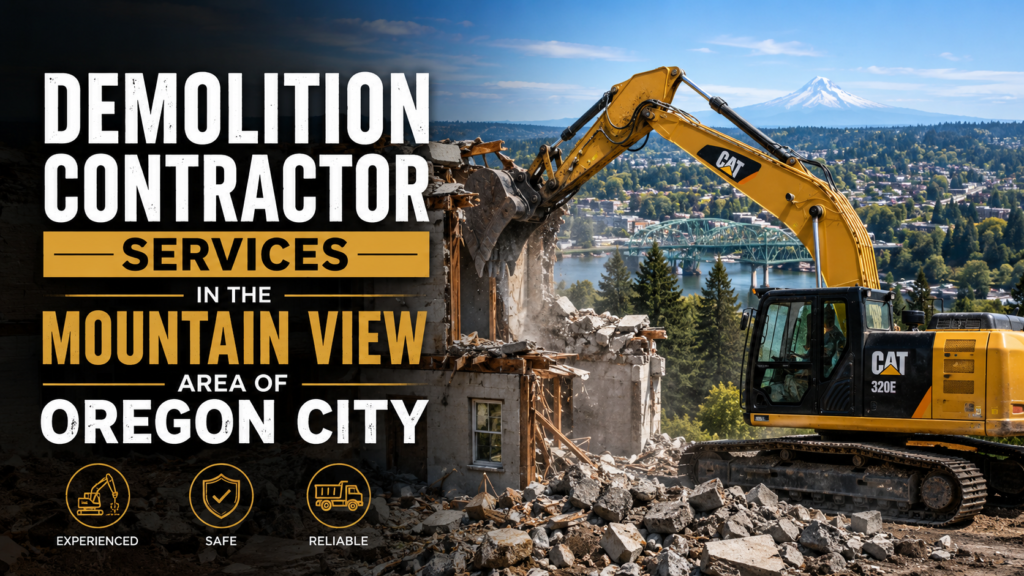
Mountain View is an area within the Oregon City community characterized by elevated terrain, established residential development, and views across the Willamette Valley and toward the Cascades. Like many of Oregon City’s hillside neighborhoods, Mountain View contains a mix of residential properties built across multiple decades, creating a landscape where older structures coexist with newer construction and where property redevelopment is an ongoing reality. Demolition Contractor Mountain View services in this setting address a range of residential and small commercial needs from accessory structure removal and home teardowns to selective interior demolition for renovations all executed within Oregon’s regulatory framework and with attention to the specific challenges of hillside site work.
Hillside Demolition: Specific Considerations for Mountain View
The elevated terrain of the Mountain View area introduces specific considerations for demolition work that flat-site projects do not present. Sloped properties affect nearly every aspect of demolition operations:
- Equipment access: Heavy demolition equipment excavators, dump trucks, and debris containers requires adequate access to the demolition site. On steep or narrow lots, access routes may be limited, requiring smaller equipment, manual work phases, or specific sequencing to manage machinery safely.
- Debris management on slopes: Controlling demolition debris on sloped lots requires more planning than on flat sites. Debris must be managed to prevent downhill migration during demolition, and clearing operations must proceed in a controlled sequence.
- Erosion control: Slopes with disturbed soil are significantly more vulnerable to erosion than flat sites. After demolition, the exposed ground on hillside lots must be stabilized promptly through seeding, erosion blanket application, or other measures to prevent soil loss during Oregon’s rainy season.
- Structural sequencing: On sloped lots, the demolition sequence must account for the structural role of the terrain itself. Retaining walls, foundation systems designed for slope stabilization, and structures built into the hillside may require different approaches than structures on level ground.
Residential Demolition Needs in Mountain View
Mountain View’s residential character generates demolition needs typical of established hillside communities:
- Older home removal: Homes built in the 1950s through 1980s that have reached the end of their economically maintainable life are periodically removed to make way for newer construction. Oregon City’s hillside views make these lots desirable for replacement with contemporary homes.
- Garage and carport demolition: Attached and detached garages, particularly those built in the mid-twentieth century, are common demolition projects in Mountain View. These structures frequently contain asbestos in roofing materials, floor tiles, and textured coatings.
- Deck and patio demolition: Hillside lots often feature extensive decks with significant elevation above grade. When these structures reach the end of their service life, demolition and removal require careful approach to manage the height and debris safely.
- Interior renovation demolition: Many Mountain View homes undergoing renovation begin with selective interior demolition removing dated finishes, partitions, and mechanical systems to create the space for modern upgrades.
Oregon City’s Permit Process for Demolition
The City of Oregon City administers a demolition permit process through its Building Department. Key elements of this process include:
- Permit application: A demolition permit application must be submitted and approved before structural demolition begins. The application typically requires information about the structure, confirmation of utility disconnection, and may require a site plan showing the structure’s location relative to property boundaries.
- Utility confirmation: Portland General Electric, NW Natural Gas, and the City’s water and sewer departments must confirm disconnection before demolition proceeds. This protects workers from electrical and gas hazards and prevents damage to the public utility infrastructure.
- Neighborhood notification: For certain project types, the City’s permit process may include notification requirements that give neighboring property owners awareness of planned demolition activity.
- Historic review: Oregon City’s location as a historically significant city means that some structures may be subject to historic preservation review. While most Mountain View residential structures are not within formal historic districts, contractors should be aware of the City’s historic preservation program and confirm whether any applicable structure has historic designation.
Environmental Considerations in Mountain View Demolition
The Pacific Northwest’s natural environment creates specific environmental considerations for demolition projects in the Mountain View area:
- Stormwater management: Oregon’s significant rainfall means that exposed soil on demolition sites is quickly subject to erosion and runoff. Oregon DEQ and the City of Oregon City require appropriate stormwater controls on construction and demolition sites, including silt fencing and temporary erosion protection.
- Tree protection: Oregon City has tree protection regulations that may require specific protection or replacement of significant trees that are removed or potentially damaged during demolition operations. Property owners should consult City regulations regarding tree removal as part of demolition planning.
- Sensitive areas: The Mountain View area’s hillside terrain and proximity to natural features means that some properties may be adjacent to sensitive natural areas, wetlands, or drainage features that require additional care during demolition.
Post-Demolition Site Conditions on Hillside Lots
After demolition is complete on a Mountain View property, the site must be appropriately restored to a stable and safe condition. On hillside lots, this is particularly important because the removed structure may have been providing some stabilizing function to the slope either directly through its foundation system, or indirectly through the impervious surface that was channeling water in defined directions.
Post-demolition site work on hillside lots typically involves foundation removal or partial fill, backfilling with engineered fill material properly compacted in lifts, establishing positive drainage to prevent water accumulation on the disturbed area, and applying erosion control vegetation or protective cover promptly. Leaving a disturbed hillside lot unprotected through a Pacific Northwest winter is not acceptable the erosion potential is too great and the impact on neighboring properties too significant.
Conclusion
Demolition contractor services in the Mountain View area of Oregon City require an understanding of hillside site conditions, Oregon’s regulatory framework for demolition and hazardous materials, and the specific characteristics of the area’s residential building stock. Property owners planning demolition projects on Mountain View’s elevated terrain can approach their projects with greater confidence by understanding what the work involves from the pre-demolition hazardous materials survey through the post-demolition site restoration that prepares the cleared parcel for its next use.